Wednesday, May 31, 2006

New harddrive

I just installed my new Seagate Momentus 100GB 7200RMP harddrive in my Toshiba Tecra M4. There is a noticeable difference in speed when using the computer, especially in disk-intensive applications like video-editing apps etc. The computer boots faster, and applications generally loads quicker. The whole thing just feels quick and snappy.

The upgrade process took me approx. 45 minutes, using Acronis True Image to clone the disk. I chose the Seagate disk after reading this report comparing a few small SATA harddrives. Thanks to these threads on the Tablebuzz.com forums for hints and tips!

Wednesday, May 24, 2006

Homework and Google

Allthough this is not a Tablet PC issue, I just have to share the story with you.

One of my daughters were doing here homework yesterday. Her task was to find the names of birds and plants from small black and white images on a hand-out. The funny thing was that instead of opening her book to find the answers, she turned to Google Images and startet to search. For each image she made a few guesses that she entered in Google Images search. If the resulting images resembled the ones on the hand-out, she trusted that she had found the correct answers and wrote them down. When I checked, almost all of her answers where correct.

I'm loving my new battery-pack

Last night I even left my powerchord at work when I left. Since tomorrow is ascension day I didn’t take the chance to leave it at work tonoght. I will try to stay on batteries to see how long they really last. Right now (after a couple of hours of use) the battery meter tells me that I’ve got approx. 6 hours 30 minutes left. It feels good! Next week I hope I’ll be able to order a new 7200 RPM SATA harddrive to further enhance my Tablet PC experience.

Thursday, May 18, 2006

Edit and Continue in VS 2003

I’m mainly using Visual Studio for my development, allthough I have Visual Studio 2005 installed on my computer. There are two main reasons for doing this. First and foremost, VS2003 is less resource hungry than VS2005. Allthough I can run VS2005 on my Tecra without problems, 99% percent of the time I doesn’t use any of the functionality of the newer version. Secondly, our product is done in .Net 1.1, and we dont have the time at the moment to port it.

One of the new cool features of VS2005 is Edit and Continue: http://weblogs.asp.net/scottgu/archive/2006/05/08/445742.aspx

I was a bit surprised when I saw this, since I’ve been using the functionality in VS2003 for a long time. Here is how we do it:

  • Open your project in Visual Studio (2003) and hit Ctrl+Alt+P (Processes)
  • Select the aspnet_wp process and press attach. Make sure you select attach to the Common Library Runtime
  • Set a breakpoint in your code (this can of course be done before attaching to the process) and access the page from your browser.
  • When your application breaks, change something in your code and build the application again.

We use this all the time, and don’t have any problems with working this way. We’re also simultaneously debugging legacy asp-code and javascript in the browser in VS2003., which is helping us finding errors in our application and prevent bugs that we’d otherwise would spend a lot of time debugging.

Google's new Java2Ajax kit

Google has just released it Google Web Toolkit, a set of tools that compiles java source code to browser-compliant Javascript and Html.

Since I’ve been interested in (and used) Ajax, I tried the demos that they have published. I am also running Internet Explorer version 7, and have turned on all the debugging functionality in the browser so that I see all javascript errors when watching a web page.

When trying to run the Dynamic Table Example demo, I got a javascript error saying “object doesn’t support this property or method”. This is a typical javascript error you get when f.ex. trying to access a new window you have opened that doesn’t exist (because it might have been caught by a popup-blocker). The same happened when trying the Kitchen Sink demo. Same reason, the javascript doesn’t check if a new window was really created.

I tried to run the demo in Firefox, and everything went fine. Since I always keep old versions of Internet Explorer aruond, I also tried it in IE 6, and it did work.

Not a very big issue, Google, but you should probably have catched the error in your framework when run in IE7.

New battery for my Tecra M4

Today I finally recieved my new battery for my Toshiba Tecra M4. The battery replaces the dvd unit (which hasn’t been used much) and was easy to install.

Now my battery meter is telling me that I’ve got approximatly 9 hours of battery left. As you might have noticed before, I’ve done a few things to optimize my M4 to make it run cooler and less noisy. I don’t think I’ll have the time to check out how long the batteries will last (I need to get some sleep as well), but I’ll see what happens in the next few days.

Next up is exchanging the built-in 5400 RPM harddrive with a 7200 RPM 100 GB  HD to improve boot time and try to further improve the performance of my Toshiba.

Btw, congratulations to Eric Mack who has finally become a YABHTU!

Thursday, May 04, 2006

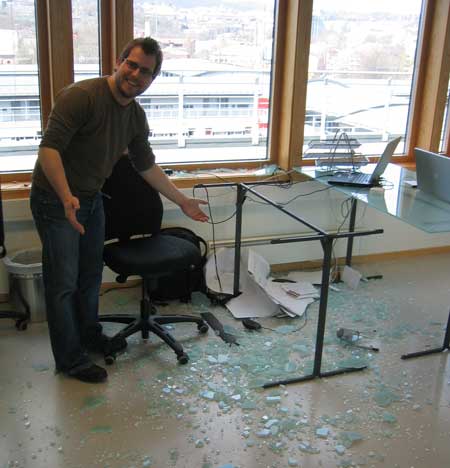
I broke my table - and my tablet survived

A couple of hours ago I broke my office table. It's a table made of glass (although rather thick glass) and it literaly exploded in front of me. I was standing beside the table, so I wasn't hurt except for a small cut in my left thumb.

On my desk I had my beloved Toshiba Tecra M4 and a nice Powerbook (that I have to validate web pages in Safari). They both fell down, but none of them was hurt. My Tablet PC was caught hanging by the ethernet cable and my eargoogles cable. The only thing that took any damage was my mouse. It's full of scratches and cuts.

And I spent a couple of hours cleaning up. In the picture below I've managed to put the two computers on the nearest table (which is now my new table).

Wednesday, May 03, 2006

Update to the Fan Control Utility

Just wanted to post a note about a very small update to the utility. Thanks to thebithead, I’ve changed the menu item for changing cooling method to “Cooling Method”. Not a big update.. :-)

The tool is updated and downloadable from here.

Programming Fonts

There has been a couple of postings lately about programming fonts. I found a link to this page with a list of recommended programming fonts, but none of the fonts suited me. I think they’re too small. I’ve been using a font called Bitstream Vera Sans Mono that I’ve been very happy with. Today Scott Hanselman blogged about a new font called Consolas, which looks very nice. I’ve posted a picture to show the differences between the Bitstream Vera and the Consolas fonts:


The Consolas font is the font on the right hand side of the picture

Saturday, April 29, 2006

The fan/brightness controll utility

If you'd like to try out the fan and brightness utility, please download it here. The utility has the following features:

* Change brightness in 8 steps
* Change fan speed in three steps
* Remembers settings (put it in your startup directory)
* Remembers settings and switches between them when you change from AC to battery.

Known issues:

* When comming back from standby or hibernate, changing the fan speed wont work before you run the tpsmain.exe program.

The program is supposed to replace the Toshiba Power Management software, and works great together with the Notebook Hardware Control.

Tuesday, April 25, 2006

Do I want to release my little fan/brightness utility?

Warner Crocker is asking me if I’d like to release the little utility I just blogged about how I wrote here, here and here. The answer is yes. There are just a few issues I need to resolve before releasing it into the public (Whenever I return from suspend mode, calling the functions for setting the cooling method wont work, and I need to run tpsmain.exe to reset something. I’m looking into it, and will keep you all posted)

Remember that this tool is supposed to be used together with a utility for controlling the processor/ speed/voltage (I’m using Notebook Hardware Control). My little utility only replaces the code for automatically adjusting the brightness and cooling method when switching between battery and ac operation.

The picture I posted yesterday was of course from running on batteries. When running on AC the “battery optimized” fan speed makes the computer a bit hotter, the temperature lies between 50–60 C, but always closer to 50 than 60.

Monday, April 24, 2006

Results?

You're probably interested in hearing what the results are after running the Fan Utility for while. See the picture to show you that I managed to keep the computer quite cool and running for quite a while with the fan in battery mode and the processor in "slow motion".

Yes, approx three hours of battery time, and a cool computer (around 40C). And all this with Notebook Hardware Control and my own custom fan control utility that also turns down the screen brightness.

Sunday, April 23, 2006

Finishing of the Fan utility

From my last posts you’ve probably read that I managed to find out how to declare and use the APIs for getting and setting the cooling method on my Toshiba Tecra M4.

When I develop applications I always spend some time researching before I start to write the final program. I also throw away the code I write in the research phase so that I can start all over, believing that doing things twice increases the quality of my programs.

The initial design for my utility was a small program that would rest in the tray area letting me change the cooling method from a simple pop up menu. After some thinking I found out that I some additional features that would be nice to have:

  • Setting the brightness level of the screen (to save power when running on batteries)
  • Add functionality for automatically changing between settings when using batteries and when running from an AC power source

Getting and setting the brightness level was an easy task to accomplish since both the functions GetBrightness and SetBrightness were exported by the Toshiba DLL I was using. The interfaces for these functions were almost the same as for getting/setting the cooling method.

Receiving notifications when switching power sources is easy to do in C#. I remembered reading an article on Codeproject.com about getting notifications about power source changes written by Al Gardner. The article how to use the SystemEvents.PowerModeChanged event and also described how to retrieve information about the current power source using PInvoke to call the Windows API GetSystemPowerStatus.

Creating a Tray Application in C# is simple, all you have to do is create an ordinary WinForms application, set the main form’s ShowInTaskBar property to false and its WindowState property to Minimised.

In addition I added a NotifyIcon component to display an icon in the tray area and a ContextMenu component with the menu options I needed (remember to set the NotifyIcon’s context menu property to point to the context menu you just created).

The rest was just a matter of connecting events to the functionality I had previously discovered, and to write some code for reading/writing the settings for the application to/from the registry.

I’m currently testing the application on my Toshiba Tecra M4, and if all goes well I’ll post a copy of it here on my blog.

Friday, April 21, 2006

Continuing the development of my little utility

Previously I posted an article about the development of a little utility for controlling the fan on my Toshiba Tecra M4. The last thing I wrote was that I had tested the APIs for retrieving the current cooling method. Next up I had to find a way to set the cooling method.

The function SetCoolingMethod seemed to be a good starting point, and since I recently had some success using a pointer to a pointer to an integer (which in c# is declared as ref IntPtr paramname), I tried this with the SetCoolingMethod function as well. I wrote the interfaces in my little test project, and fired it up from within the debugger. This time the program crashed with a null pointer exception. I tried several different ways of declaring the parameter, using integers, pointers to integers and the pointer to a pointer to an integer.

I did some research to see how the Toshiba Power Management software were using the function, and saw that it seemed to send two parameters to the function. I tried to pass two pointer-to-a-pointer-to-an-int parameters to the function, and this time it worked – the fan suddenly stopped spinning like crazy when I fed it with the value 2 as the first parameter!

I now had a way of both getting and setting the cooling method, and was all set to go to build a real program that utilized this knowledge.

Stay tuned for my next post.

Thursday, April 20, 2006

Programming the Lego Mindstorms kit

A couple of years ago (ok, eight years or so), I went to my local toy store and bought the Lego Mindstorms Robotics Invention kit for my kids (they were only three years old at the moment, but the guy behind the counter didn’t know :-). I built quite a few robots, among them were roverbots using infrared lights for prozimity detection and even a dragracer that changes gears when it reached a certain speed. It was fun!

I’ve been waiting for the next version of the Mindstorms kits, and really enjoyed an article I read at the MSDN Coding for Fun site about a .Net SDK for communicating with the RCX. I found the link over at Scott Guthries blog.

A small utility for controlling the fan

I’ve blogged about power management on my Toshiba Tecra M4 Tablet PC before, and have done a lot of thinking on how I could minimise fan noise and maximise the battery lifetime. I’ve blogged about my favourite program for undervolting and controlling processor speed, Notebook Hardware Control (which I can recommend), and I’ve blogged about discarding the Toshiba Power Management program.

Lately I’ve investigated how I could control the fan speed on my computer to minimise the noise the fan is making (which a lot of people has complained about). I started to dig to see if I could find any tools to remedy this problem. I knew that I wouldn’t install the Toshiba Power Management software again, since it has a bad habbit of interfering with the Notebook Hardware Control.

I found some utilities that claimed to control the fan, but none of them worked on my Tecra M4. So I set out on the journey to create a new utility. First of all I started to search for some system utilities that could provide me with an interface to the functionality I was looking for. I took a sneak peek into the Toshiba Power Management software, and found out that it used some functions in a DLL called TPeculiarity.dll. The dll exposes a few functions that seemed interesting for what I was looking for:

  • GetCoolingMethod
  • SetCoolingMethod

Of course there are no publicly available interfaces to these functions, so all we could do is guess. From previous experiences with APIs, I guessed that GetCoolingMethod would take a pointer to a pointer to an integer and fill it with the correct data on return. Using Visual Studio 2003 and C#, I could quickly create a small test project that verified that my assumptions were correct.

In my next post I’ll give you some more information on how I developed my utility!

Wednesday, April 19, 2006

A small IE7 request from a Tablet PC user

I’ve been using IE7 (beta 1/2) for a couple of months now, and it has a lot of features that I really enjoy (and I’m not talking CTRL+Q). Among the nice things I like are the small things that makes my workday (and spare time) easier. As an example is the functionality that gives focus to a window where something has happened or where a new page has been loaded.

This led me to ask for the following feature: Why can’t the same happen with a newly opened page in a frame?

Here is my scenario: I’m sitting in my sofa reading all my feeds with bloglines in Tablet PC mode. Each time I click on a link in the left frame, the right/main frame changes it’s active/selected page. To start reading (which involves scrolling), I need to perform an additional click in the right frame to give it focus. Otherwise the Tablet PC button will scroll the contents in the left frame. This is really annoying, since I need to double click twice as many times as necessary.

Please…

Wednesday, April 05, 2006

PSP Development

Scott Hanselman posts a great article about PSP development as an interview with his friend Doug Beck. The article talks about the constraints (and possibilities) of the PSP platform.

For developers like me that are used to automatic memory management and almost unlimited memory on today’s platforms, the article brings back a lot of memories from building compilers and development tools for the PalmOS platform, embedded development in C, writing games in BASIC on my Dragon 32 etc.

Tuesday, April 04, 2006

More on temperatures

I previously wrote that I wasn’t using the “Dynamic Switching” scheme for setting processor speeds dependent on the processor load because I thought it made the computer running hotter. Again, by accident, I switched to “Dynamic Switching” mode, and presto, the temperature dropped to 42C, and it’s been there since!

As I write this, I’m doing development in C# (VS 2003 with Ankh installed) and Javascript, testing in both Firefox and Internet Explorer while running Microsoft Defender in the background! And the temperature is still 42. The fan is running, but only at semi-fast speed (ie. not too noisy).

UPDATE: And after a few hours the computer just turned black, and had to be rebooted. I’m still running in Dynamic Switching mode, but I need to do some more testing with different voltages. I’ve now just turned all multipliers from 8 to twelve.

Friday, March 31, 2006

Toshiba Tecra M4 Power Management

By accident the preinstalled Toshiba Power Management stopped working. I’d experienced this once before, and it had something to do with the software not being able to read from the registry. This time I didn’t have time to fix the problem, so I decided to continue without it. I’m running the Notebook Hardware Control as my tool of choice for undervolting the processor on my Tecra M4.

I had previously been under the impression that I needed the Toshiba Software to control the fan on my laptop, but after a few hours I found out that because I’m undervolting my (almost) stripped computer (running AVG anti-virus software instead of the hungry Norton Suites and almost none of the preinstalled Toshiba utilities) the processor isn’t running hot anymore and the fan doesn’t kick in at it’s highest speeds. The temperature stays between 50–52 and 58C.

I’ve updated the undervolting settings from last time I wrote about it. Now I’m running at 0.988V at full speed, and 0.716V at the lowest speed. I’ve also noticed that running in either “Performance”– or “Max Battery” mode makes the processor running colder than when using the dynamic switching or battery optimized modes.

In addition, undervolting the computer gives me a bit more battery. I’m usually getting almost three hours on my Tecra now. It’s the best computer I’ve ever had. Honestly!
